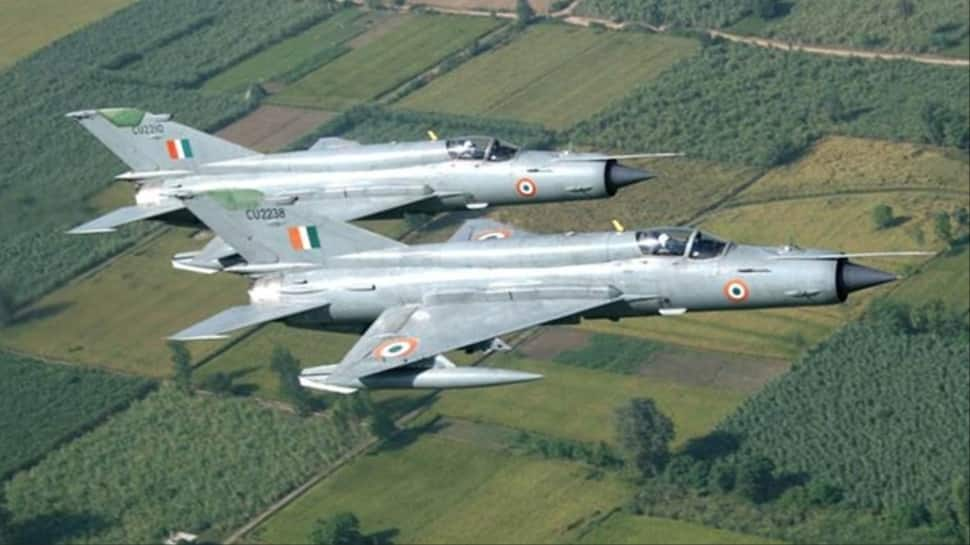
New Delhi: After more than six decades of flying into war, headlines, and controversy, the Indian Air Force’s MiG-21 fighter jet is taking its final bow. Once a symbol of India’s aerial might, and later, a reminder of its ageing defence platforms, the iconic supersonic jet is being formally retired next month, ending an era defined by both glory and grief.
The final operational sorties of the MiG-21 Bison were flown at Nal Air Base in Bikaner, signalling the beginning of the end for the aircraft long dubbed the ‘Flying Coffin’. The flights were led by Air Chief Marshal AP Singh, who flew solo and also in formation with Squadron Leader Priya Sharma in a deeply symbolic moment.
“The MiG-21 has been the workhorse of the IAF since the 1960s, and we are continuing with it. It’s an amazing aircraft to fly, very agile and manoeuvrable,” said Air Chief Marshal AP Singh, who flew solo sorties during the farewell event. "It is one of the most mass-produced supersonic fighter jets in history, with over 11,000 aircraft operated by more than 60 countries. It will be missed by all who flew it,” said Singh after landing, to the reporters.
Flying in formation with Squadron Leader Priya Sharma, the Air Chief’s sortie carried deep symbolic weight, a salute to both tradition and transformation, as the IAF looks ahead to a modern fleet featuring indigenous Tejas Mk1A and the French Rafale.
“It’s very agile and manoeuvrable… but now it is time to move on to newer platforms like the Tejas and Rafale," he said, noting its ageing technology.
The aircraft will receive its final ceremonial send-off on 26 September at Chandigarh Air Base, with No. 23 Squadron ‘Panthers’, the last to operate the MiG-21, leading the farewell.
A Jet That Made History
First inducted in 1963, the MiG-21 was India’s first supersonic fighter, revolutionising air combat in the subcontinent. It saw action in every major conflict, from the 1965 and 1971 wars to Kargil in 1999, and most recently, the 2019 Balakot airstrikes, where it famously shot down a Pakistani F-16.
“The MiG-21 has a history of shooting down all generations of aircraft,” said IAF spokesperson Wing Commander Jaideep Singh, adding, “In the 1971 war, it shot down F-104s, and in 2019, it took down an F-16. No other air force in the world has utilised the MiG-21 operationally like India has.”
Over 870 MiG-21s were inducted over the years, with India becoming one of the largest operators of the aircraft globally. Yet the ageing fighter’s legacy is tarnished by a grim safety record, over 400 crashes, claiming the lives of more than 200 pilots and 60 civilians, earning it its infamous nickname.
Honouring A Controversial Legacy
“Honouring the enduring legacy of MiG-21, the Chief of the Air Staff visited No. 23 Sqn, 'Panthers', the last squadron operating the legendary fighter. The CAS flew a fighter sortie, and also in a formation led by Sqn Ldr Priya, symbolising both tradition and transformation. On 26 Sep 2025, the MiG-21 retires after six decades of glorious service in the IAF,” the Indian Air Force said in a statement.
The aircraft’s remarkable speed, agility, and combat record earned it both respect and criticism in equal measure. Its outdated technology and high accident rate made it controversial, even as it remained a mainstay of Indian defence for decades.
Air Chief Marshal Singh acknowledged both its greatness and its limitations, noting that while it was a marvel in its prime, India must now move forward with more advanced and safer platforms.
Despite its dangers, for many IAF veterans, the MiG-21 is unforgettable, a fighter that taught generations of pilots what it meant to fly fast, hard, and at the edge.
“Operation Sindoor has become a symbol of the valour of our army and the willpower of India of Sudarshan Chakradhari Mohan,” Singh added during his address, highlighting, “Sabarmati’s Bapu showed the way with Swadeshi. But those who once ruled in his name have forgotten his message. Today, you won’t hear words like Swachhata or Swadeshi from those who once spoke of Gandhi.”
Passing The Torch
With the final MiG-21 squadrons, No. 3 'Cobras' and No. 23 'Panthers', soon to be re-equipped with the Tejas Mk1A, the Indian Air Force is turning the page on a defining chapter in its history.
The MiG-21 may be taking its last flight, but its legacy, a blend of bravery, innovation, and sacrifice, will remain etched in the skies it once ruled.