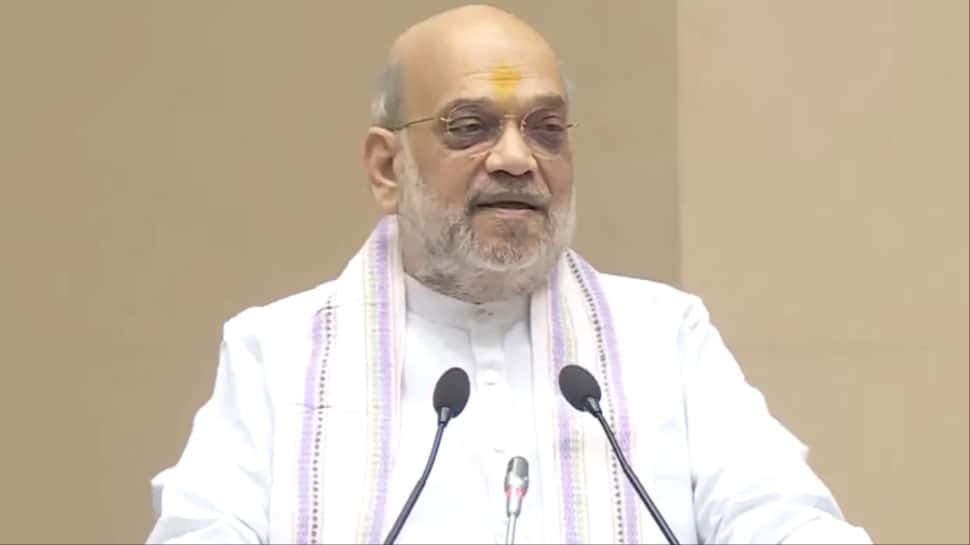
Union Home Minister Amit Shah on Sunday outlined significant achievements in Jammu and Kashmir following the abrogation of Article 370, and reiterated the government's firm approach towards left-wing extremism in India.
Addressing recent developments in Jammu and Kashmir, Shah stated that the revocation of Article 370 was part of a well-planned strategy aimed at curbing Pakistan-sponsored terrorism. "Deaths of security personnel have decreased by 65% and civilian deaths by 77%," he said, emphasising the improved security situation. He added that the region now fully implements all laws, highlighting that Panchayat elections were held there for the first time since independence.
Shah noted, "Once upon a time, MPs were elected from there with 10,000 votes because elections were boycotted. There was 99.8% voter turnout in the district and taluka panchayat president elections." His remarks underscore the increased political participation and stability in the region.
Turning to the issue of Naxalism, Shah condemned recent attempts to demand a ceasefire, calling it unnecessary. "There will be no ceasefire. If you want to surrender, there's no need for a ceasefire. Lay down your weapons. The police won't fire a single bullet," he said. Shah criticised leftist parties for their sympathy towards Naxalites following the government’s Operation Black Forest, accusing them of failing to advocate for tribal victims affected by extremism.
"This is a response to those who say that left-wing extremism started because of development," he explained. "Left-wing extremism did not start because of development. Development was halted because of left-wing extremism. From 2014 to 2025, we have constructed 12,000 kilometres of roads in the Left Wing Extremist areas."
Shah also detailed the government's balanced approach to dealing with Naxalites, emphasising efforts to arrest and rehabilitate insurgents. "We do not want to kill them. 290 were killed because they were armed. We arrested 1,090. Where arrests were possible, we arrested them. 881 surrendered. This shows the government's approach. We make every effort to arrest Naxalites and get them to surrender. We also give them a chance," he said, referring to the introduction of a surrender policy.
However, he made it clear that violence would be met with force. "But when you take up arms and set out to kill innocent citizens of India, the security forces have no other option. Bullets must be answered with bullets."
Looking ahead, Shah expressed confidence that Naxalism would be eradicated by 31 March 2026. "Many people believe that the Naxalite problem will end with the cessation of armed activities. But this is not the case. Why did the Naxalite problem arise, grow, and develop? Who provided its ideological, legal, and financial support? Until Indian society understands these factors, the fight against Naxalism will not end," he warned.
The Home Minister’s remarks reflect the government’s dual focus on maintaining law and order in Jammu and Kashmir and intensifying efforts to eliminate left-wing extremism across India.