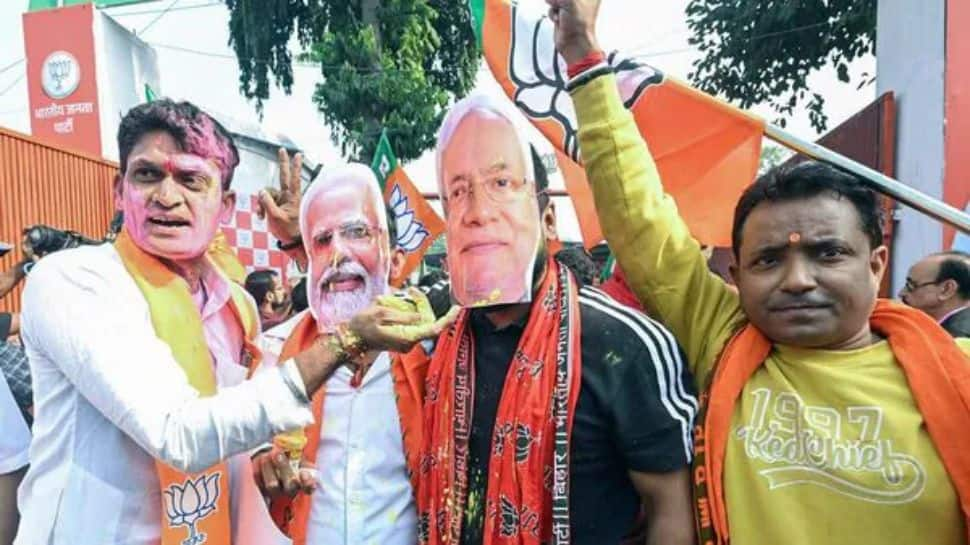
Bihar Assembly Election 2025: The state has delivered one of the most emphatic mandates in recent years. The National Democratic Alliance (NDA) dismantled the Mahagathbandhan’s challenge through a potent combination of women-centric welfare schemes and cash transfers, strategic caste alignments and disciplined organisational management.
The NDA tally hovers around the 200-plus mark, reflecting strong performance of the Bharatiya Janata Party (BJP), a resurgent Janata Dal (United) or JD(U) and allies such as the Lok Janshakti Party (Ram Vilas) or LJP(RV) and the Hindustani Awam Morcha (Secular) or HAM(S). The sweep is a testament to Nitish Kumar’s “phoenix” comeback, Prime Minister Modi’s enduring appeal and Chirag Paswan’s remarkable strike rate.
From the surge in women voters to the collapse of dynastic challengers, the Bihar results provide a clear snapshot of the state’s political realignment. Here are the 10 key takeaways:
1. Unstoppable Nitish
Chief Minister Nitish Kumar has repeatedly proven his political resilience, and the electorate reaffirmed this once again. Despite Opposition labels like “Paltu Ram” for frequent alliance shifts, voters prioritised his record on infrastructure, law and order and women-focussed welfare over past political manoeuvres.
Health-related attacks fell flat, as his campaigning and long-term delivery (pensions, rural roads, electricity and Rs 10,000 cash assistance to nearly one crore women) reassured voters. Even the taunting slogan “25 se 30, phir se Nitish” emerged as a nod to continuity rather than criticism.
2. Modi’s Pull
Prime Minister Modi’s appeal continues to consolidate floating voters. His speeches, rallies and focus on welfare messaging reinforced the NDA’s narrative.
Viewed alongside Haryana, Maharashtra and Delhi results, Bihar 2025 confirms that Lok Sabha 2024 was an anomaly rather than a trend and Modi remains an electoral factor.
3. Chirag’s Strike Rate
Chirag Paswan converted seat allocations into victories in challenging constituencies. His influence over Paswan/Dalit voters contributed a 5-6% swing in key areas.
With 22 wins out of 29, the LJP(RV) now commands significant leverage in government formation and portfolio allocation.
4. Jan Suraaj’s Reality
Prashant Kishor’s Jan Suraaj initiative failed to convert hype into results. Despite media attention, the party made minimal impact beyond a few spoiler roles.
Bihar 2025 highlights the enduring importance of grassroots organisation over star-led campaigns.
5. Identity Alone No Longer Wins
Despite his status as the natural opposition leader, Tejashwi Yadav could not overcome caste constraints or the NDA’s welfare-oriented shield.
Smaller regional parties struggled to maintain relevance. The verdict shows that identity alone does not deliver victory; credibility, economic messaging and cross-caste coalitions are increasingly decisive.
6. Opposition Fails To Challenge NDA
The results highlight Opposition weakness along with NDA’s strength. The Rashtriya Janata Dal (RJD) has shrunk since its 2015 peak, the Congress is reduced to single digits and Left parties are negligible.
The Mahagathbandhan or INDIA bloc’s tactical unity failed to counter the NDA’s disciplined strategy, leaving the coalition exposed.
7. Schemes Blunt Anti-Incumbency
Direct benefit transfers, pensions and women-focussed welfare emerged as decisive factors. Voters preferred schemes they had already experienced over untested promises.
Bihar 2025 confirms that the perceived welfare credibility, rather than ideological positioning alone, now mitigates anti-incumbency.
8. Record Turnout Proves Decisive
A record turnout of women voters (5 lakh more than men) proved pivotal. Nitish Kumar’s long-term women-centric policies and the Rs 10,000 assistance scheme resonated widely.
National welfare narratives reinforced this impact, creating a powerful and decisive female electorate. Women are no longer symbolic voters; they are central to electoral outcomes.
9. SIR Issue Fizzles
Months of debate over the Special Intensive Revision (SIR) of voter rolls and deletions did not translate into voter anger. High turnout and smooth polling indicate that the SIR issue was largely rhetorical rather than operational.
10. New Entrants Fail To Gain
Despite high participation and concerns over unemployment, young voters did not coalesce around new entrants like Jan Suraaj. Many preferred the security of familiar parties, signalling that generational shifts remain incremental rather than transformative.
11. Discipline Now Beats Ideology
Coalitions are no longer only about ideology or shared enemies; operational coherence and strategic discipline are key.
The NDA held together despite internal tensions, while the INDIA bloc appeared brittle and ad hoc, illustrating that effective alliances now hinge on disciplined execution.
What Bihar Truly Indicates
Bihar election results demonstrate that modern Indian politics hinges on a blend of delivery and identity. In the state, controlling welfare channels, mobilising women voters and strategically assembling caste coalitions proved far more decisive than slogans or political theatre.
For the Opposition, the message is loud and clear: without credible governance models and cohesive alliances, even traditional bastions can slip away.