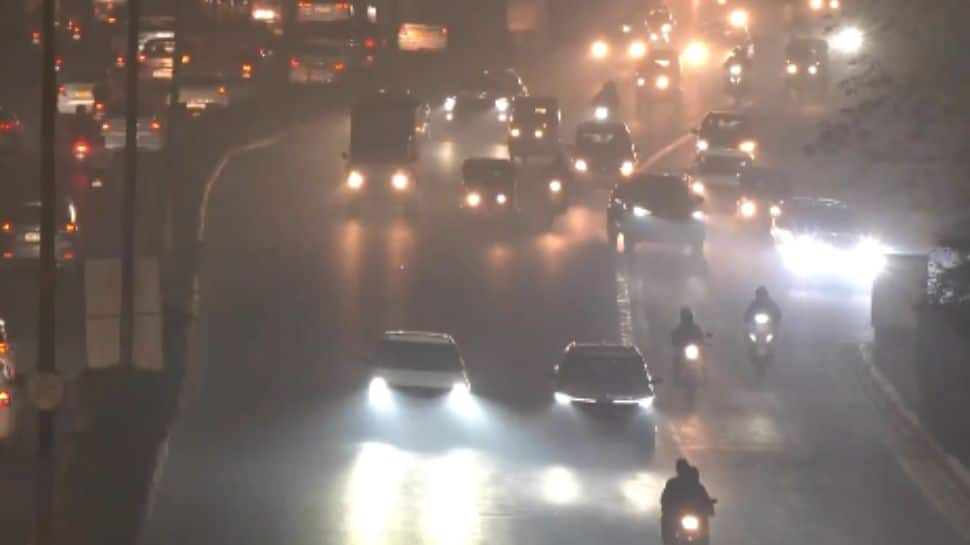
Delhi's air quality deteriorated on Sunday, hovering dangerously close to the 'severe' mark in several places while the overall Air Quality Index (AQI) in the national capital was recorded at 390 in the 'very poor' category.
The AQI in 19 places in Delhi reached "severe" levels, while the rest recorded "very poor" air quality, according to the Central Pollution Control Board (CPCB).
As per CPCB standards, an AQI between 0 and 50 is considered "good", 51 to 100 "satisfactory", 101 to 200 "moderate", 201 to 300 "poor", 301 to 400 "very poor", and 401 to 500 "severe."
Earlier this week, Delhi's air quality saw a brief improvement, with pollution levels falling into the 'poor' category on Wednesday and Thursday. However, this respite was short-lived, as air quality deteriorated again on Friday, with pollution levels rising sharply, according to data from the Central Pollution Control Board.
This decline continued on Saturday, when the overall air quality worsened further and remained in the 'very poor' category across the city.
In response to the worsening conditions, the Commission for Air Quality Management (CAQM) has invoked Stage III measures under the Graded Response Action Plan, including restrictions on construction and industrial activities.
What Is GRAP?
The Graded Response Action Plan (GRAP) is an emergency set of measures enforced across the Delhi-NCR region to control rising air pollution levels and safeguard public health during critical periods.
Stage 3 GRAP Restrictions in Delhi-NCR
Under GRAP Stage 3, several activities face restrictions to curb pollution:
- Construction and Demolition Curbs: Non-essential activities such as excavation, piling, trenching, and open-site Ready-Mix Concrete (RMC) work are stopped.
- Shutdown of High-Polluting Units: Stone crushers, mining operations, and hot-mix plants that do not operate on cleaner fuels are required to remain closed.
- Vehicle Use Limitations: BS-3 petrol and BS-4 diesel four-wheelers are barred from plying to reduce vehicular emissions.
- Material Transport Controls: The movement of construction materials, including sand and cement—particularly on non-paved roads—is restricted.
- Diesel Generator Restrictions: Diesel generators are permitted only for essential and emergency services such as hospitals, airports, and metro systems.
- Inter-State Bus Suspension: Diesel-powered inter-state buses entering or operating within Delhi are suspended to limit pollution.
- Work-from-Home Advisory: Private sector offices are advised to follow work-from-home or hybrid working arrangements.
- School Closures: Schools up to Class 5 are shut, with classes shifted to online mode to protect young children.
Exemptions Under Stage 3 GRAP
- Certain critical services are exempted under strict supervision:
- Essential Infrastructure Projects: Works related to railways, metro rail, airports, defence, sanitation, and healthcare are allowed to continue.
- Regulatory Oversight: The Commission for Air Quality Management (CAQM) and state pollution control boards will conduct continuous monitoring to ensure compliance and assess air quality.