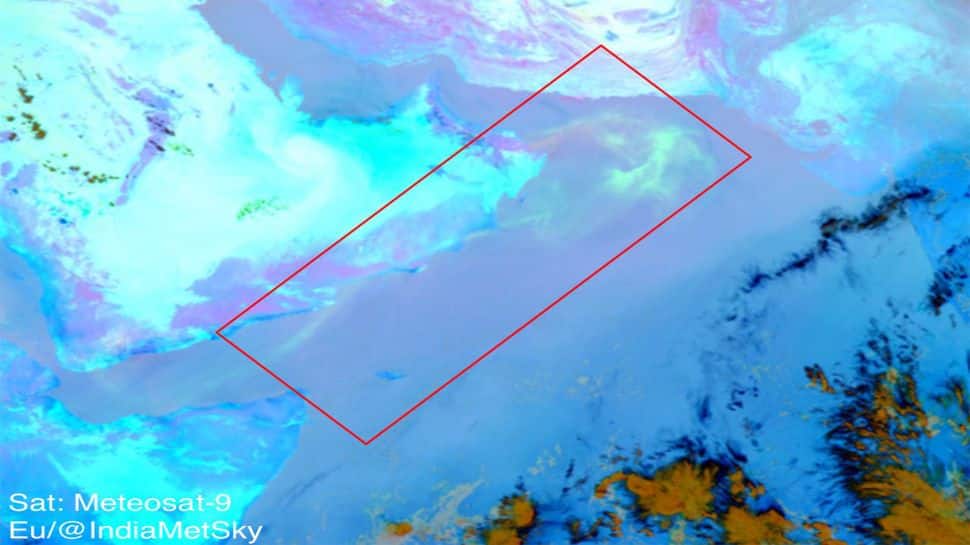
Ethiopia’s Volcanic Ash: A large ash plume rose over Ethiopia after the eruption of the Hayli Gubbi volcano. The cloud spread several kilometres above the surface. The plume travelled across the Red Sea toward the Middle East and Central Asia. The upper atmosphere over India has now come under its path.
The ash has formed a layer at a high altitude that sits far above the surface. The height matches the usual cruising zone of passenger aircraft. The India Meteorological Department has reported this zone between 8.5 and 15 kilometres above sea level. The agency has assessed the movement of the plume through satellite data.
The IMD, which has also studied its impact on day-to-day weather, expects no major change in the surface layer as the cloud is far away from the ground. The IMD has predicted a possible disturbance in satellite signals, which may cause short-term disruption in aviation. The ash reached North India on Monday night. The plume has now drifted toward China.
International and domestic flights across India have come under disruption. Many aircraft have reported delays. Several services have faced cancellation. A few routes have changed direction to avoid the ash layer. India’s aviation regulator has issued a caution notice. The authority has instructed airlines to avoid the affected zones.
The regulator has shared a list of steps for flight crews. Pilots have been told to report any sighting of ash and have also been asked to share information on engine performance. Flight crews must report any smell or haze inside the cabin.
Airlines have been asked to monitor all operations near the affected regions, as the regulator has directed airports to pause or delay flights if conditions worsen. The main safety concern arises from the engines, because volcanic ash carries extremely fine particles made of hard silicate material. This material melts when it enters the high-temperature zone of a jet engine and solidifies again once it reaches the cooler sections. The process creates a glasslike layer that blocks airflow, which can cause the engine to stall.
If an engine shuts down, it cools quickly, allowing the hardened layer to crack and fall away so the engine can restart. The recovery, however, takes time, and the risk increases during take-off or landing, because the aircraft may not have enough altitude or time to restart safely.
Ash exposure can also damage the exterior of an aircraft, since the abrasive particles strike the windows and the outer surface repeatedly, wearing them down over time. As the windscreen loses clarity, pilots face reduced visibility. The aircraft eventually requires maintenance.
The ash can impair sensors as well, causing speed indicators to produce incorrect readings and affecting navigation systems. Very fine particles can enter the cabin ventilation system, leading to discomfort for passengers and crew.
Pilots struggle to identify an ash cloud, because it does not resemble a typical weather cloud. The most reliable warning is a faint glow, which is known as St. Elmo’s fire, around the aircraft that appears when ash particles interact with the plane’s surface. Once pilots detect the glow, they turn the aircraft away and reduce engine thrust so that lower heat reduces the chance of engine failure.
Airlines rely on global tracking systems for advance planning. Nine Volcanic Ash Advisory Centres monitor the movement of ash worldwide. These centres issue hazard maps that aviation authorities use to plan safe air routes.
Several past incidents highlight the danger. A large shutdown brought European aviation to a standstill for nearly two weeks in 2010 after Iceland’s Eyjafjallajökull eruption. Many aircraft were unable to detect ash visually or on radar.
Indonesia has faced multiple airspace closures for the same reason. One of the most well-known events occurred in 1982, when a British Airways flight entered an ash cloud near Indonesia; a glow appeared around the aircraft, all four engines failed and the plane dropped from 11,300 metres to 3,650 metres before the engines restarted and the aircraft landed safely in Jakarta.
A similar incident occurred in 1989, when a KLM Boeing 747 lost all engines near Alaska after the Mount Redoubt eruption. The aircraft dropped nearly 4,000 metres before the engines restarted, allowing a safe landing in Anchorage.
Global data reviewed by the International Air Transport Association shows that volcanic ash has caused several serious aviation events, although no crash, fatality or severe injury has been recorded so far.
Meteorologists are continuing to track the movement of the current plume. Private weather agencies have said that no advance preparation was possible, since the eruption occurred in a region without specialised sensors.
The volcano had remained dormant for thousands of years, and the sudden Sunday-morning eruption sent large columns of smoke and ash into the atmosphere without warning. Experts say the ash will take time to clear and that no firm estimate is possible yet.
According to the IMD, the plume appears to be moving away from Delhi, and the skies are expected to clear by Tuesday evening as visibility improves gradually.