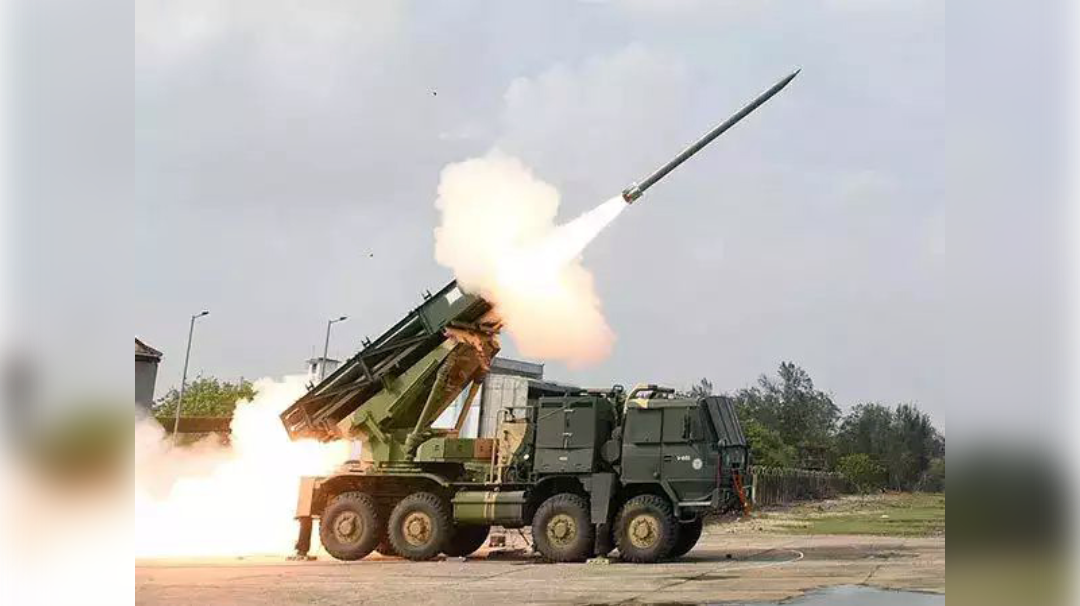
The Indian Army unleashed Operation Sindoor, a blistering response to Pakistan’s missile attacks and a terror strike in Pahalgam that killed 26 innocent people. As missiles roared and drones swarmed, India stood tall, with its Pinaka Multi-Barrel Rocket Launcher (MBRL) system and S-400 defense shield forming an “impregnable wall of fire,” as the Army’s Western Command declared on X. The operation wasn’t just a counterstrike; it was a lesson in precision, power, and pride, reducing Pakistan’s terror infrastructure to rubble. At the heart of this triumph was the Pinaka, India’s homegrown rocket artillery system, which has become a symbol of the nation’s military might and self-reliance. But what exactly is this fearsome weapon, and why does it strike fear into the hearts of India’s adversaries?
The Pinaka: A Bow of Destruction
Named after Lord Shiva’s mythical bow, the Pinaka MBRL is a battlefield juggernaut designed to rain destruction on enemy targets with unmatched speed and accuracy. Developed by the Defence Research and Development Organisation (DRDO), it’s a mobile artillery system that can launch a salvo of 12 rockets in just 44 seconds, delivering up to seven tonnes of explosives across a range of 60-90 kilometers. Its “shoot-and-scoot” capability allows it to fire and relocate swiftly, evading counterattacks in today’s drone-heavy battlefields. Each 214mm rocket carries a 100-kilogram payload, configurable with warheads like high-explosive pre-fragmented (HEPF) rounds or area denial munitions (ADM) to target enemy troops, vehicles, or infrastructure.
The system’s versatility is its strength. Guided Pinaka variants use GPS for pinpoint accuracy, while the Mk-I Enhanced and Mk-II Extended Range (ER) versions push ranges to 45 km and 90 km, respectively. DRDO is now testing a 120-km variant, with plans to extend it to 300 km, making Pinaka a strategic asset for long-range strikes. Built by Indian firms like Tata Advanced Systems, Larsen & Toubro, and Solar Industries, Pinaka embodies the “Aatmanirbhar Bharat” initiative, showcasing India’s ability to innovate and manufacture world-class weapons.
A Legacy Born in the 1980s
The Pinaka’s story began in the late 1980s at DRDO’s Armament Research and Development Establishment (ARDE) in Pune, driven by the need for an indigenous alternative to Russian rocket systems. After years of development, it was battle-tested during the 1999 Kargil War, where it pounded enemy positions with devastating effect. Since its induction in 2000, the Indian Army has deployed four Pinaka regiments, with six more in the pipeline, some stationed along the tense China border in high-altitude areas. Its combat record and rapid-fire capability have made it a cornerstone of India’s artillery firepower.
Missiles and Might: Pinaka’s Arsenal
Pinaka’s rockets are its lethal edge. The system fires 214mm rockets, each customizable for specific missions. The HEPF-Mk-1 rockets, recently contracted for Rs 5,700 crore, offer enhanced range and precision to strike deep into enemy territory. The ADM Type-1, costing Rs 4,500 crore, scatters sub-munitions to deny areas to enemy forces, crippling their mobility. In Operation Sindoor, Pinaka’s rapid salvos neutralized Pakistan’s missile attacks, as reported by The Times of India, showcasing its ability to dominate the battlefield. DRDO’s guided rockets, successfully tested in 2020, double the original range to 75 km, with ongoing trials for 120-km and 200-km variants promising even greater reach.
A single Pinaka battery, with six launchers, can fire 72 rockets in 44 seconds, blanketing targets with overwhelming force. Its fire control computer and DIGICORA MET radar ensure precision, while independent launcher modes—manual, remote, standalone, or autonomous—offer unmatched flexibility. This adaptability, paired with India’s annual production capacity of over 5,000 rockets, ensures Pinaka can sustain prolonged operations without reliance on foreign suppliers.
Global Reach: Pinaka’s Export Triumphs
Pinaka isn’t just India’s pride; it’s a global game-changer. In 2023, Armenia became its first foreign buyer, signing a $245-million deal, drawn by its cost-effectiveness and combat-proven reliability. France, a major arms supplier to India, is now in advanced talks to acquire Pinaka, a historic reversal that could mark Paris’s first weapons purchase from New Delhi. Vietnam, African nations, and ASEAN countries have also shown interest, lured by Pinaka’s performance and India’s push for defense exports under the Defense Acquisition Procedure (DAP). Despite France’s plans to test a HIMARS-like system in 2026, Pinaka’s mobility, rapid-fire capability, and affordability make it a compelling choice for modern armies.
India’s export ambitions are backed by robust production. Contracts worth Rs 10,147 crore, signed in February 2025 with Economic Explosives Limited and Munitions India Limited, ensure a steady supply of advanced ammunition. With DRDO developing longer-range variants, Pinaka is poised to cement India’s place in the global arms market, challenging systems like China’s PHL-03 and the U.S.-made HIMARS.
Operation Sindoor: A Fiery Reckoning
Operation Sindoor was Pinaka’s moment to shine. Launched on May 7, 2025, it targeted nine terror sites in Pakistan and Pakistan-Occupied-Kashmir, retaliating for the Pahalgam attack. As Pakistan’s drones and missiles struck, Pinaka and the S-400 system thwarted their assault, with debris scattered across agricultural fields. India’s counterstrike was ruthless, destroying key Pakistani military assets, including the Nur Khan and Rahim Yar Khan airbases. A Western Command video on X captured the operation’s precision, with a soldier declaring, “It wasn’t revenge; it was justice.” By May 10, Pakistan sought a ceasefire, humbled by India’s overwhelming response.
A Symbol of Strength
Pinaka is more than a weapon; it’s a testament to India’s resolve. Its thunderous barrages in Operation Sindoor sent a clear message: India will not tolerate aggression. With plans to extend its range to 300 km, Pinaka is evolving into a strategic deterrent, capable of striking deep into enemy territory. Its success on the battlefield and in export markets underscores India’s rise as a defense powerhouse. As the Army’s Western Command proclaimed, Pinaka is part of an “impregnable wall of fire,” guarding the nation with ruthless precision and raw power. For adversaries like Pakistan, it’s a warning: cross India, and face the wrath of Shiva’s bow.
(Girish Linganna is an award-winning science communicator and a Defence, Aerospace & Geopolitical Analyst. He is the Managing Director of ADD Engineering Components India Pvt. Ltd., a subsidiary of ADD Engineering GmbH, Germany.)