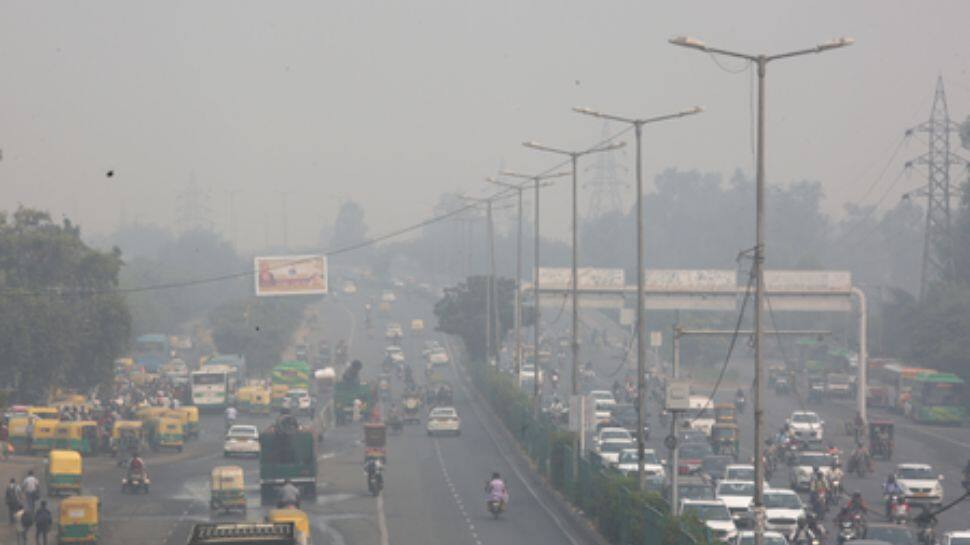
New Delhi: Delhi woke up to worsening air quality on Sunday morning, as pollution levels dropped sharply into the ‘very poor’ range and touched ‘severe’ levels in several parts of the Delhi-NCR, leaving the city covered in a thick layer of smog and haze.
A thick layer of smog covered the city on Sunday morning, and the still air trapped pollution close to the ground. This made the air feel heavy, reduced visibility, and made it harder for people across Delhi-NCR to breathe comfortably.
AQI Breaches 400 in Several Parts of Delhi
According to data from the Central Pollution Control Board (CPCB), Delhi’s average Air Quality Index (AQI) stood at 372 at 6:30 a.m., firmly placing it in the ‘very poor’ category.
Pollution levels worsened further in several parts of the city, where AQI readings crossed the 400 mark, indicating ‘severe’ air quality.
Some of the worst-affected areas included Wazirpur (425), RK Puram (418), Bawana (410), Rohini (409), and Dwarka (401), all reporting hazardous pollution levels. Most monitoring stations across the city recorded AQI readings between 300 and 400, indicating widespread poor air quality and toxic conditions.
NCR Cities Record ‘Very Poor’ Air Quality
In the NCR region, air quality remained alarmingly poor as well, with Faridabad (312), Gurugram (325), Greater Noida (308), Ghaziabad (322) and Noida (301) all recording AQI levels in the ‘very poor’ category.
Meteorological conditions contributed heavily to the pollution build-up. Delhi’s primary weather station at Safdarjung reported a visibility of 900 metres, while Palam recorded 1,300 metres, both due to a mix of fog and smog. Winds remained light, with speeds around 4 kmph, insufficient to disperse the accumulated pollutants.
The India Meteorological Department (IMD) reported that Delhi recorded a maximum temperature of 30.5 degrees Celsius, about three degrees below the seasonal average, and a minimum of 19.4 degrees Celsius, slightly above normal. Humidity stood at 73 per cent on Saturday evening, further aiding the formation of smog.
Saturday night’s AQI was 303, already in the ‘very poor’ range, but overnight stagnation and low wind speed caused a sharp spike by morning.
Experts cautioned that Delhi’s air quality may worsen in the coming days if strong northwesterly winds or rainfall don’t arrive. They added that ongoing stubble burning, vehicle emissions, and other local pollution sources are continuing to build up in the atmosphere, making the city’s air increasingly unhealthy and difficult to breathe.
(From the Inputs on IANS)