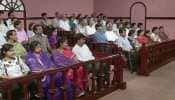
In northern-central Madagascar's mountainous terrain lives a strong ethnic tribe whose mere name is a declaration of defiance. The Tsimihety, which literally translates to "those who never cut their hair," have managed to make their looks a living archive of their defiance against the state and traditions imposed upon them for centuries.
Today, however, despite the misleading presentations of their appearance seen on some of the virally popular trending sites on the web, the Tsimihety continue to be an important symbol of egalitarianism and the liberty of the individual within the rapidly modernising society.
Members of the Tsimihety people of Madagascar — a black African ethnic group whose name literally means “those who never cut their hair.” For generations, hair has symbolized freedom, identity, and resistance to imposed traditions. Unlike many cultures where hair is cut during… pic.twitter.com/RMpJGVl8RC
— PTE Gahene (@Kay2506) December 22, 2025
The Blade Of Resistance: A Sacred Tradition
The fact that the Tsimihety do not cut their hair is not only an expressive cultural statement, as it is in this case, but it is also an historical assertion against the power of the Sakalava Kingdom. It was an historical fact that, as an act of mourning, all subjects of the Sakalava Kingdom had to shave their heads in anticipation of the death of the king.
However, by refusing "the blade," these Tsimihety ancestors proclaimed that they and their descendants would be a leaderless and independent people. This is because today, their long hair symbol.
Freedom: Freedom from obligatory rituals of colonization or of kingship.
Ancestry: A living tradition that holds the body should be as it had been at birth, in respect for the ancestry of the plains of Mandritsara.
The "Anarchists"
Anthropologists Graeber, the late David Graeber, and Professor Peter Wilson, to name two, state that the Tsimihety are one of the most successful anarchist societies in the world.
Unlike most other neighboring tribes, the Tsimihety did not have a traditional tribal order and social contract. The social structure of the Tsimihety is defined by:
Egalitarianism
Belief that it's unethical to give an order, and a person who leads others is always questionable.
Kinship Focus: Society is focused completely on the biological relatives and ancestors, rather than a state and a chief.
Consensus-Based Living: Decisions are made by an informal community consensus, sometimes frustrating the colonial administrators who found that "no one in charge" to negotiate with.
Economy and Modern Life
Despite their anarchist roots, the Tsimihety have turned into one of the most dynamic and mobile populations in the country, numbering over 1.2 million today, around 7% to 10% of Madagascar's population.
Agriculture: They are excellent cattle breeders and rice growers; they used to exploit the productive Mandritsara plains.
Migration: Known for their high birth rate and strict rules of exogamy, they have expanded across the island in search of new pastures.
Political Influence: Far from being isolated, the Tsimihety have become active in national politics. The first president of the independent Malagasy Republic, Philibert Tsiranana, was a Tsimihety.
Culture Vs. Viral Misinformation
In the digital content era, images from different African tribes are often incorrectly labeled as that of Tsimihety in order to gain "likes."
Anthropologists and community advocated call for distinguishing real Tsimihety culture from internet exaggeration. Tsimihety tradition is not a costume but an industrious, centuries-old survival strategy against Merina expansion, French colonialism, and the digital age.