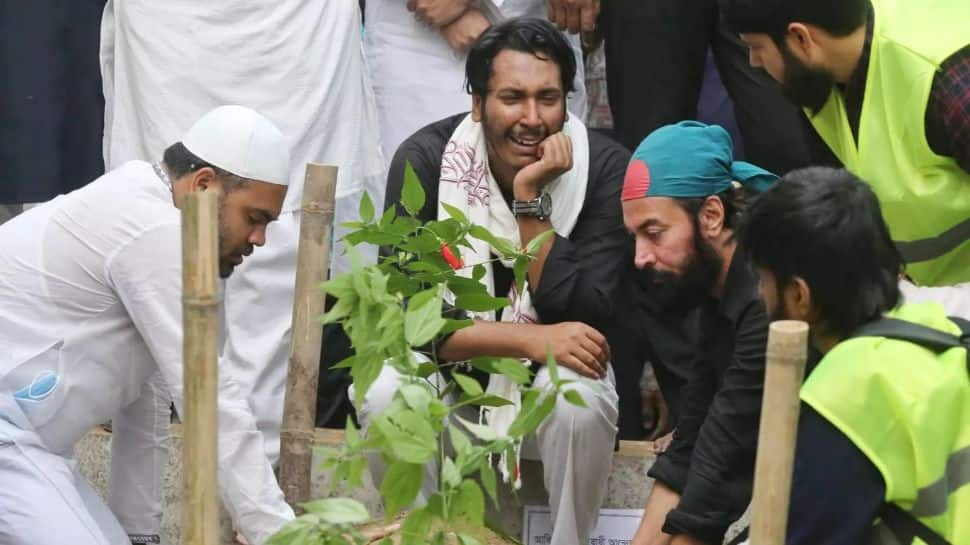
Bangladesh Unrest: The Dhaka University campus saw a massive turnout on Saturday (December 20) as student leader Sharif Osman Hadi was laid to rest. Interim government chief advisor Mohammad Yunus attended the funeral, highlighting the political and social significance of the event.
Bangladesh Unrest: Nearly 50 years after Bangladesh’s rebellious poet Kazi Nazrul Islam was buried near Dhaka University’s mosque in 1976, another person of defiance, student leader Sharif Osman Hadi, was laid to rest at the same site on Saturday (December 20). He was killed allegedly in a carefully orchestrated assassination, and his funeral drew a crowd of unprecedented proportions.
Millions flooded the streets of the capital, while thousands travelled from nearby towns and cities to take part in the funeral, effectively filling the city with a sea of mourners.
Hadi was buried next to Kazi Nazrul Islam, a parallel that has stirred discussion across Bangladesh. While many observers view the connection as natural, since Nazrul’s poetry had inspired Hadi’s activism, social media reels and viral clips show him using the poet’s verses as a symbolic weapon.
Similarly, critics of Prime Minister Sheikh Hasina’s administration began portraying him as a “Biplobi” (a revolutionary), echoing Nazrul’s legacy.
During his rallies, Hadi often recited stanzas from Nazrul’s poetry, “I am the storm, I am the whirlwind. I am the unstoppable Rudra (untamed power, fury and unstoppable energy), the restless roar. The sky shatters at my laughter, the heavens soar at my touch. I come as a flood, embracing waves with my chest. I uproot trees, break roofs and play all games of fear. I am the fire-spewing whirlwind, the dance of death swims in water. People tremble, the city trembles and dust falls at my feet.”
Hadi emerged as the self-proclaimed heir to Nazrul’s revolutionary spirit, especially after leading the anti-Hasina student movement under the banner of the political platform Inquilab Manch. He was a vocal critic of Indian influence in Bangladesh and frequently spoke against Hasina’s Awami League.
The 32-year-old was planning to contest the Dhaka-8 seat as an independent candidate in the February 2026 general elections in the country.
On December 12, while travelling in an electric rickshaw, he was shot at by unknown attackers and later died in a Singapore hospital. The attack came one day after the Bangladesh Election Commission announced that the country’s first general election following Hasina’s departure would take place on February 12, 2026.
The alleged shooter, Faisal Karim, reportedly told his girlfriend the night before, “Something is going to happen that will shake all of Bangladesh.”
Following Hadi’s death, hundreds of protesters took to the streets of Dhaka. Islamist elements allegedly infiltrated the crowds, plunging the capital into violence and chaos. Cultural centres were vandalised, and attacks targeted Sheikh Mujibur Rahman’s residence. Indian diplomatic missions and media houses, including ‘The Daily Star’ and ‘Prothom Alo’, which are critical of both Hasina and Yunus’s governments, faced attacks and arson.
The unrest occurred months ahead of national elections, with the interim government, allegedly backed by Islamist support, holding power. Demonstrators shouted anti-Hasina and anti-Awami League slogans throughout Dhaka, while security forces was on high alert.
Yunus himself attended Hadi’s funeral and delivered an emotional address. “Dear Osman Hadi, we have not come to bid you farewell. You live in our hearts, and as long as Bangladesh exists, you will live in the heart of every Bangladeshi,” he said.
Authorities tightened security around the funeral, deploying the police, the Rapid Action Battalion (RAB), Ansar and military personnel. At Shahbagh Circle, crowds demanded justice for Hadi’s killers, chanting slogans that had recently become common in anti-India protests, “Not Delhi, Dhaka. Dhaka-Dhaka.”
The Inquilab Manch has petitioned to rename Shahbagh Circle in honor of the slain student leader.
Controversy Over Hadi’s Burial Next To Nazrul
Dhaka University Proctor Saifuddin Ahmed confirmed that the decision was finalised during an emergency online meeting of the university syndicate after midnight. The decision followed two applications submitted by the Cabinet Division and the Dhaka University Central Students Union (DUCSU). The site was surveyed, empty plots were mapped and final approval was granted.
Since September, the DUCSU has allegedly been under the influence of Jamaat-e-Islami’s student wing, Islami Chhatra Shibir. Cabinet Division chief advisor Mohammad Yunus’s executive office played an important role in the process.
According to The Daily Star, the Inquilab Manch stated that Hadi’s family requested the burial next to Nazrul, causing intense debate.
Awami League supporter Mostofa Amin criticised the decision, saying Nazrul symbolised tolerance and secularism; whereas, Hadi represented extremism and identity-based hatred. He described the burial adjacent to Nazrul’s grave a political act.
On the other hand, former Chattogram journalist A. Rahman Mitu called it a blessing, hoping the graves of Nazrul and Hadi would rest on the same axis.
Online debates on secular Bangla subreddits showed deeply divided opinions, with some calling the juxtaposition shameful.
Born in 1993 in Jhalokathi district, Hadi moved to Dhaka and began his political journey at the Dhaka University, which became the laboratory for his activism. The massive turnout at his funeral reflects his widespread influence in post-Hasina Bangladesh.
During the July-August 2024 movement, he energised youth by reciting Nazrul’s revolutionary poetry.