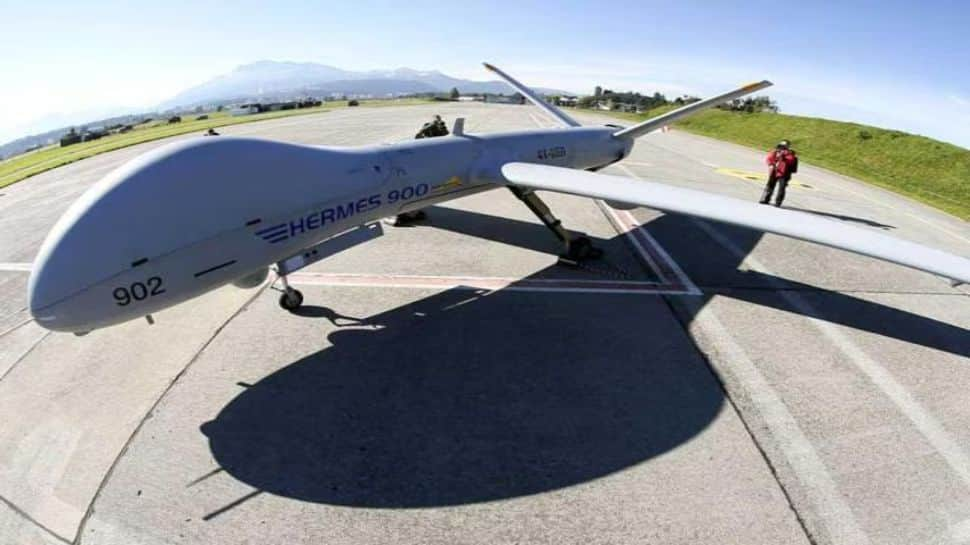
Hermes-900 Drones: Tel Aviv witnessed a rare moment of candour from Israeli defence executives this week as they discussed how drones guided Israel’s operations during the 12-day conflict with Iran this June. Amir Betesh, vice president at Elbit Systems, told audience at the UVID Drone Tech Conference that Israel leaned heavily on its Hermes-900 “Kochav” drones throughout the fighting to track some of Iran’s most closely guarded assets.
He said the Hermes-900 fleet picked up the signatures of at least 12 hidden Iranian ballistic missile launchers, a task the Israeli Army had struggled with for years. He explained that the drones carried out this surveillance while also helping strike mobile air-defence units, radar installations and several munition facilities.
“During the Iran war, nearly 70 percent of Israel’s flight hours belonged to drones, not fighter jets,” he revealed while publicly sharing these details for the first time, according to The Jerusalem Post.
The Hermes series has long been counted among the world’s more capable military drones. Betesh used the conference to argue that medium-sized drones still form a crucial layer of Israel’s national security ecosystem.
The discussion quickly moved toward where unmanned warfare is heading. Orbit Communications’ Daniel Eshchar told attendees that the world is inching toward an era in which machines increasingly take over the battlefield. He believes human dependence in high-risk operations will continue to shrink, although skilled pilots will still remain essential for missions that require delicate judgement or complex manoeuvres.
XTEND’s co-founder and CXO, Matteo Shapira, added his perspective on how autonomy is evolving inside drone design. He said that remotely controlled and assisted-autonomous drones have been around for years, but task-based autonomy is still relatively new.
Engineers are now trying to develop mission-based autonomous drones that can maintain pursuit of a target, hold position and make quick tactical decisions to avoid losing the trail.
Shapira suggested that in a future conflict with Iran, swarms of such mission-based autonomous drones may be deployed over Tehran. These systems will not be fully independent, he said, but they may carry out time-bound operations with minimal human intervention.
Across the conference, there was broad agreement that drone technology has exploded in scale and capability. Companies are building platforms of all sizes, each with its own methods for launch, landing and field control, allowing militaries to execute increasingly varied tasks.
Betesh later told Israeli reporters that Elbit Systems is now working on defensive upgrades to protect its platforms from growing threats on the battlefield. He said this is an urgent priority after Israel’s recent confrontations with Hezbollah and Iran.
For India, the discussions in Tel Aviv held special relevance. Known in Israel as the Kochav or “Star”, the Hermes-900 is not only one of Israel’s most lethal drones but also a system that India already operates.
Elbit manufactures the platform in partnership with Adani Defence, and the drone’s recent performance is being seen as reassuring news for New Delhi.
The Hermes-900 can stay airborne for more than 30 hours and is used for reconnaissance, surveillance, targeted strikes and a wide range of military missions.
Israel first unveiled the platform during its 2014 conflict in Gaza, and its role has expanded dramatically in subsequent years.
The latest revelations from Israel’s drone industry have added a new layer of interest in India’s defence circles, especially as unmanned warfare grows increasingly advanced and more autonomous in conflicts across the region.