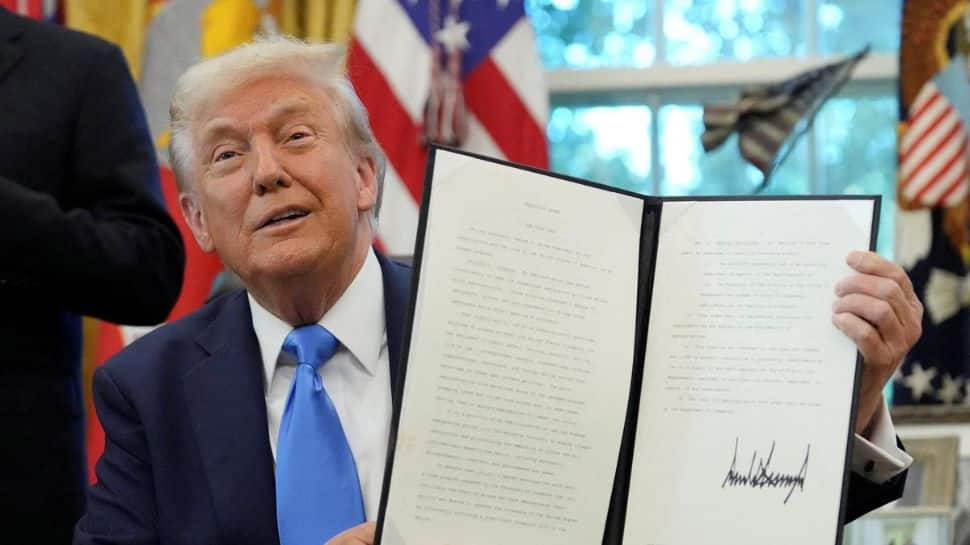
Washington: President Donald Trump rocked the US tech industry with a sudden and steep surge in H-1B visa fees. The decision sent shockwaves across Silicon Valley and beyond. Companies now face a staggering $100,000 per application, up from $2,000-$5,000. The cost hike is designed to push employers to hire American workers over foreign talent.
Created under President George H.W. Bush in 1990, the H-1B visa has long been a gateway for highly skilled foreign professionals. Last year, Indian nationals claimed 71% of approved H-1B visas, followed by Chinese applicants at 11.7%. Experts warn that Trump’s move could trigger a brain drain, forcing top global talent to turn to other nations that are eager to welcome them.
“The fee is a one-time fee on submission of a new H-1B petition,” the White House clarified, highlighting that holders of existing visas and applications submitted before September 21 will not be affected.
The Department of Homeland Security will now prioritise high-skilled and high-paid applicants in the H-1B lottery. Additional changes are under consideration.
Critics argue that H-1B visas have been misused to hire foreign workers at lower wages than Americans would command. The Government of India is reviewing the full implications, with the Ministry of External Affairs warning, “This measure is likely to have humanitarian consequences by way of the disruption caused for families.”
A Blow To Tech Industry
Roughly two-thirds of H-1B jobs are in tech, with giants such as Amazon, Google, Microsoft, Meta and Apple relying heavily on foreign specialists.
Microsoft reassured employees that current visa holders could stay in the US “for the foreseeable future”. Elon Musk, a former H-1B recipient, reminded people in 2024 on X (formerly Twitter), “The reason I am in America along with so many critical people who built SpaceX, Tesla and hundreds of other companies that made America strong is because of H-1B.”
Global Winners Eye Skilled Talent
Trump’s H-1B fee surge is shaking the US talent ecosystem. While American tech faces uncertainty, countries around the world are poised to turn this disruption into a historic opportunity to scoop up the world’s best brains.
United Kingdom: In the wake of Trump’s hike, Prime Minister Keir Starmer is exploring abolishing visa fees for skilled foreign workers.
The UK’s “global talent task force” aims to attract top scientists, digital experts and academics to fuel economic growth.
China: Beijing is preparing to launch the K Visa on October 1, allowing Science, Technology, Engineering and Mathematics (STEM) professionals to study and work in China without a prior job offer or research position.
The Ministry of Foreign Affairs welcomed global top-tier talent.
South Korea: Presidential Chief of Staff Kang Hoon-sik said ministries are being instructed to exploit US visa changes, targeting scientists and engineers to support an AI and technology-led economy next year.
Canada: Canada has already lowered the cut-off score for its Comprehensive Ranking System, inviting more skilled workers for permanent residence.
Authorities are also considering reintroducing a 2023-style visa programme to attract H-1B holders to migrate for up to three years.